
Upgrading Hotel Locks to RFID: An Owner's Planning Guide
Plan an RFID lock upgrade in 6 steps: why hotels leave magstripe, MIFARE chip families, phased rollout, PMS and encoder checks, and a decision table.
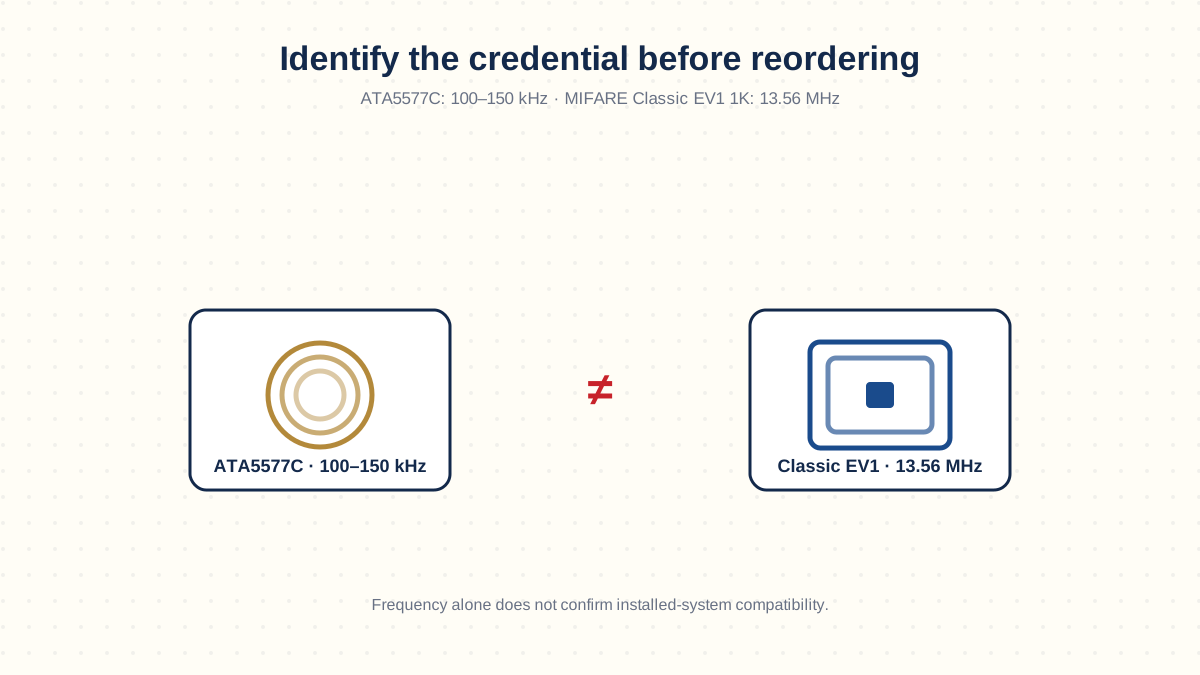
When a hotel reorders key cards, matching the printed design is only part of the job. The installed locks, encoder and credential configuration determine what can be issued and used. A card described as “T5577” and one described as “MIFARE Classic 1K” should not be treated as interchangeable stock.
This guide is for hotel staff and procurement teams working with their authorized system provider. Establish the exact specification before ordering; a brand name, country of manufacture or price bracket is not a credential specification.
For the T5577-family label, the documented reference here is Microchip’s ATA5577C. Its data sheet specifies a low-frequency operating range of 100–150 kHz and identifies 125 kHz and 134 kHz applications. It is a contactless read/write identification IC. Confirm the exact part supplied rather than assuming every card sold under a broad family label is identical. Source: Microchip ATA5577C data sheet.
NXP’s MIFARE Classic EV1 1K operates at 13.56 MHz, uses an ISO/IEC 14443 Type A contactless interface and has 1 kB of EEPROM. Those specifications identify a chip family; they do not establish that a hotel’s software can issue an accepted credential on it. Source: NXP MIFARE Classic EV1 1K data sheet.
| Check | ATA5577C reference | MIFARE Classic EV1 1K reference |
|---|---|---|
| Radio frequency | LF, 100–150 kHz | HF, 13.56 MHz |
| Supplier confirmation | Exact IC and supported credential specification | Exact IC variant and supported credential specification |
| Hotel acceptance | Verify with the installed encoder and locks | Verify with the installed encoder and locks |
These are different radio interfaces. Frequency is a useful first filter, but sharing a frequency does not establish matching protocols, credential configuration or access permissions.
NFC works at 13.56 MHz and includes several supported technologies. A generic NFC response therefore does not establish that a card is MIFARE Classic. Source: NFC Forum’s technology overview.
A negative result is also inconclusive: Android explicitly makes MIFARE Classic support optional. Phone hardware, app support and presentation can affect what is detected. “My phone sees nothing” does not prove a low-frequency card or a damaged credential. Ask the hotel’s system provider to verify the card using supported equipment and the procurement record. Source: Android MifareClassic documentation.
Do not assume that a reader or card must support only one radio technology. HID documents a reader supporting both 125 kHz and 13.56 MHz technologies and multi-technology credentials combining HF technologies with 125 kHz Prox. LUX-IDent also documents combination cards with two chips in one card.
These examples do not establish support for ATA5577C in a particular reader or hotel system. Confirm the exact reader configuration and every credential technology required; a dual-technology label is not universal compatibility.
NXP currently marks MIFARE Classic EV1 as not recommended for new designs. Existing compatibility is not a reason to recommend Classic as a modern security default. For a new installation or an upgrade, have the system provider assess supported credential options and the migration plan. A newer chip is not automatically a drop-in replacement. Source: NXP MIFARE Classic EV1 product page.
For a broader starting point, use the key-card chip guide or lock compatibility finder. If an existing card has stopped working, the hotel operations checks help separate the observed symptom from a confirmed cause.
Share equipment models and a non-sensitive requirements summary when discussing samples. Keep guest information, live credential contents and security secrets inside the hotel’s authorized support process.
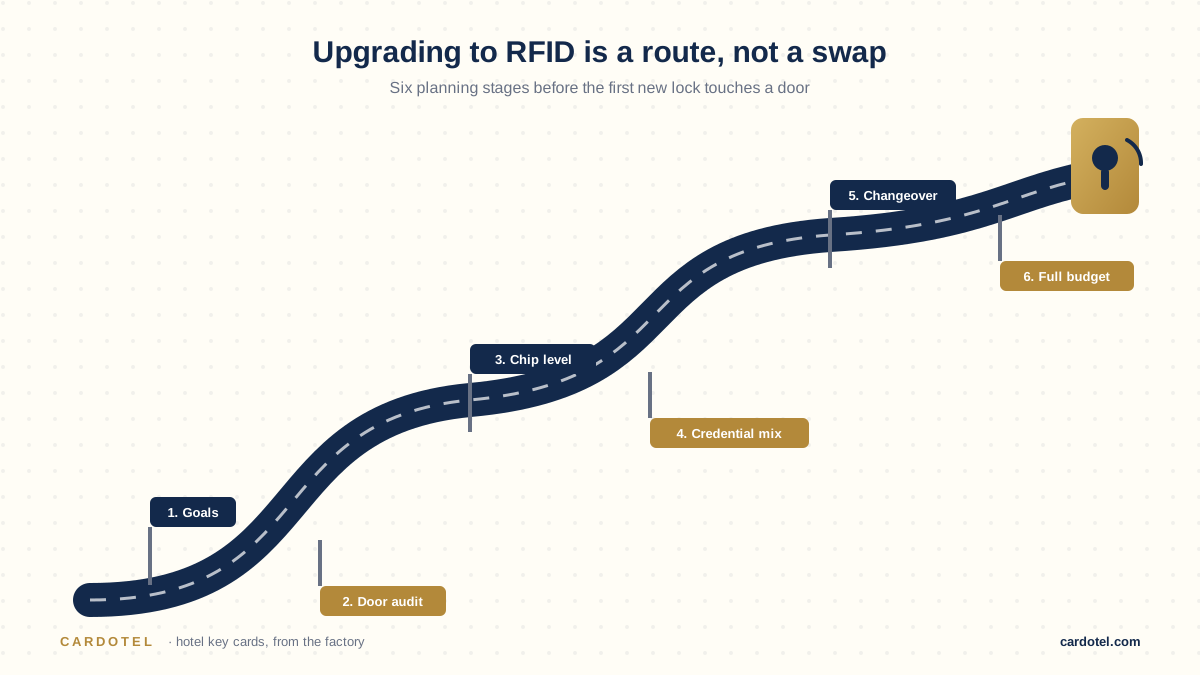
Plan an RFID lock upgrade in 6 steps: why hotels leave magstripe, MIFARE chip families, phased rollout, PMS and encoder checks, and a decision table.

Hotel key cards rely on rotating codes and encrypted chips to stay secure. An honest look at what protects guests, and where the real risks actually sit.

A practical guide to encrypted hotel locking systems: what encryption really means, who actually needs it, and what it costs versus standard RFID.