
Eco-Friendly Key Cards
Wood, bamboo and paper options, with composition and sourcing evidence to review.
Boutique & Eco Hotels
A key card guests keep on purpose
In a property built on details, a plastic rectangle is a missed moment. Wood grain, letterpress-style finishes and honest materials turn the key into part of the stay.
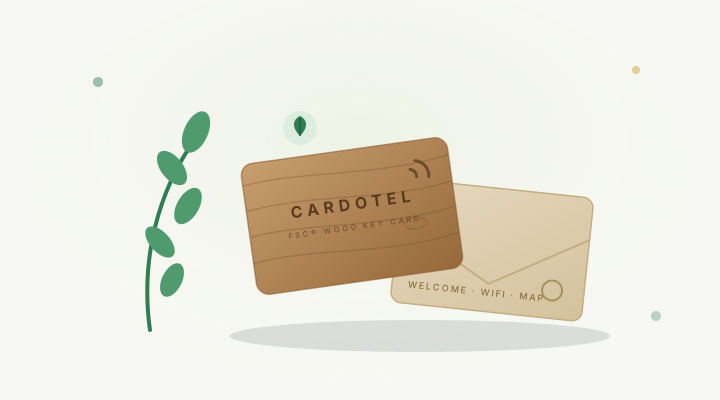
Select a product to review its options, request a quotation or plan the samples your team needs before ordering.
Wood, bamboo and paper options, with composition and sourcing evidence to review.
RFID and magstripe cards for your hotel’s installed access system.
Custom-printed key card sleeves, key fobs, staff ID cards and linen tags that complete the program.
Sample contents and charges, production timing and shipping are confirmed for your project.
Prepare your project brief
Wood, bamboo, paper and PVC options need separate checks for construction, environmental claims, appearance and use in your locks.
Use the reorder form to share your previous order reference, new quantities and any changes.
For a boutique or eco-positioned hotel, the key card is a detail guests actually notice — and the material does the talking. The realistic choices are wood or bamboo veneer, waterproof paper and alternative PVC formulations, each with its own look, cost level and set of claims that can honestly be printed about it.
The trade-offs in one line each: wood and bamboo feel substantial and engrave beautifully but vary naturally in grain and sit at the top of the price range; coated paper is the lightest and lowest-cost of the three but shows edge wear sooner on long stays; degradable PVC looks and handles like standard PVC, and its environmental story rests entirely on the specific formulation’s test evidence.
Veneer cards with engraved or printed artwork; species, finish and moisture limits chosen per project.
A distinctive grain and tone below most wood species on price, with the same engraving options.
Coated paper-based cards, the lowest-cost eco option; fiber, coating and inlay composition specified per order.
Kraft or fine-paper sleeves that carry the same design language as your in-room print.
We quote the full construction — veneer or fiber, coatings, adhesive, RFID inlay — so every claim you print can point at a document.
Wood outside, ordinary RFID inside: the chip is specified against your locks exactly as it would be on a PVC card.
Guests photograph and keep wooden cards — your logo leaves with them, in a good way.
Green claims on guest-facing items get checked — by guests, by journalists and increasingly by advertising regulators. Before printing "sustainable" on anything, request the complete card composition (veneer or fiber, coatings, adhesive and the RFID inlay), the sourcing documents behind any certified-wood claim including the certificate’s scope and validity, and the exact test report behind any degradability claim — specimen, method, conditions and result. A material name alone proves none of this.
Two posts unpack the paperwork: FSC-certified wooden key cards explains what a chain-of-custody claim covers, and degradable PVC vs compostable PLA compares what each material’s test standards do and do not establish.
Grain and shade vary card to card, so approve an acceptable range on physical samples rather than a single reference. Humidity matters too: veneer and paper cards should be sampled under conditions like yours — in tropical climates, coated paper behaves differently from raw stock. The electronics are unaffected by the surface: match the chip to your locks as with any card, and test an engraved or printed sample in your own doors and encoder before the full run.
The full picture — cost, durability, guest reaction and alternatives — is in wooden key cards: pros, cons and cost.
For typical stay lengths, usually: the coating takes the surface wear, and engraved artwork is cut into the veneer rather than printed on top. They are stiffer than PVC and vary naturally, so approve a sample range up front and pull worn cards the way you would scuffed plastic. Verify water, heat and cleaning limits for the exact construction you order.
Waterproof paper generally comes in lowest, with bamboo above it and wood at the top; where each lands depends on construction, finish and quantity. The cost guide publishes indicative per-card ranges for all three. See the cost guide
Coated and laminated paper cards handle wet hands and splashes. "Waterproof paper" describes the coated stock, not immersion-proof electronics — and it does not automatically mean plastic-free or recyclable. Ask for the composition and test a sample against your stay length and climate.
Start your order
Share the material preference, complete-card requirements, lock system, quantity and destination. Identify any sourcing or disposal evidence your procurement team requires.