
Does Your Hotel Need an Encrypted Locking System?
A practical guide to encrypted hotel locking systems: what encryption really means, who actually needs it, and what it costs versus standard RFID.

Guests occasionally worry that a hotel key card is an easy target — cloneable in a hallway, hackable from a laptop, or secretly storing sensitive personal data. Some of that concern is outdated. A narrower version of it is legitimate and worth understanding. Here's an honest look at both.
This is a mechanical and systems question as much as a card question, so it's worth starting with how a hotel key card system actually enforces security in the first place.
Hotel locks don't just check "is this a valid card" — they check whether the card presents the next code in a running sequence programmed into that specific lock. When a new guest checks in, their card gets encoded with the next code in line, and the lock automatically invalidates the previous code the first time the new card is used. That's why a card from three guests ago simply stops working, without anyone manually resetting anything.
Most lock hardware also runs on battery power, independent of any building network, and keeps a local, time-stamped log of every access attempt. Security staff can pull that log after any incident to see exactly which credential tier entered a room, and when.
What's typically not there, contrary to a persistent internet myth: a credit card number, a guest's name, or a home address. Mainstream encrypted RFID and standard magstripe encoding simply weren't built to carry that kind of data in the first place, regardless of whether the card itself is standard PVC or an eco-friendly alternative.
If a card carrying section-wide or property-wide access goes missing, that section needs to be re-coded — full stop. This is exactly why those higher tiers deserve tighter sign-out logging and restricted access in the first place, a point covered in more depth in our breakdown of hotel key card types.
Older, unencrypted magstripe installations are more vulnerable than current encrypted RFID platforms from established lock brands like Saflok, Onity, SALTO, VingCard, or Kaba. A property still running decades-old lock hardware should treat an upgrade as a security investment, not just a cosmetic refresh.
Security researchers have demonstrated cloning attacks against certain older RFID chip families, but only under controlled lab conditions with specialized equipment. Current-generation encrypted chips combined with sequential coding make casual, opportunistic cloning impractical in a real hallway — though it's still a reason to keep lock firmware current rather than treat it as a one-time install.
| Risk factor | How it's mitigated |
|---|---|
| Lost or stolen guest card | Instant deactivation and reissue with a new sequential code |
| Lost master or grandmaster card | Full re-code of the affected section |
| Old, unencrypted lock hardware | Scheduled upgrade to encrypted RFID platforms |
| Casual card copying | Sequential/rotating codes make old copies invalid on first new use |
For more on how these systems work day to day, see our FAQ.
Planning an order? Contact Cardotel with your lock and encoder details, required card or wristband specification, quantity per design and destination. Request a project quote and confirm sample availability, charges, preparation and shipping.

A practical guide to encrypted hotel locking systems: what encryption really means, who actually needs it, and what it costs versus standard RFID.

Losing a hotel key card isn't a security crisis. Here's what guests should do next, and the reissue procedure every hotel front desk should have ready.
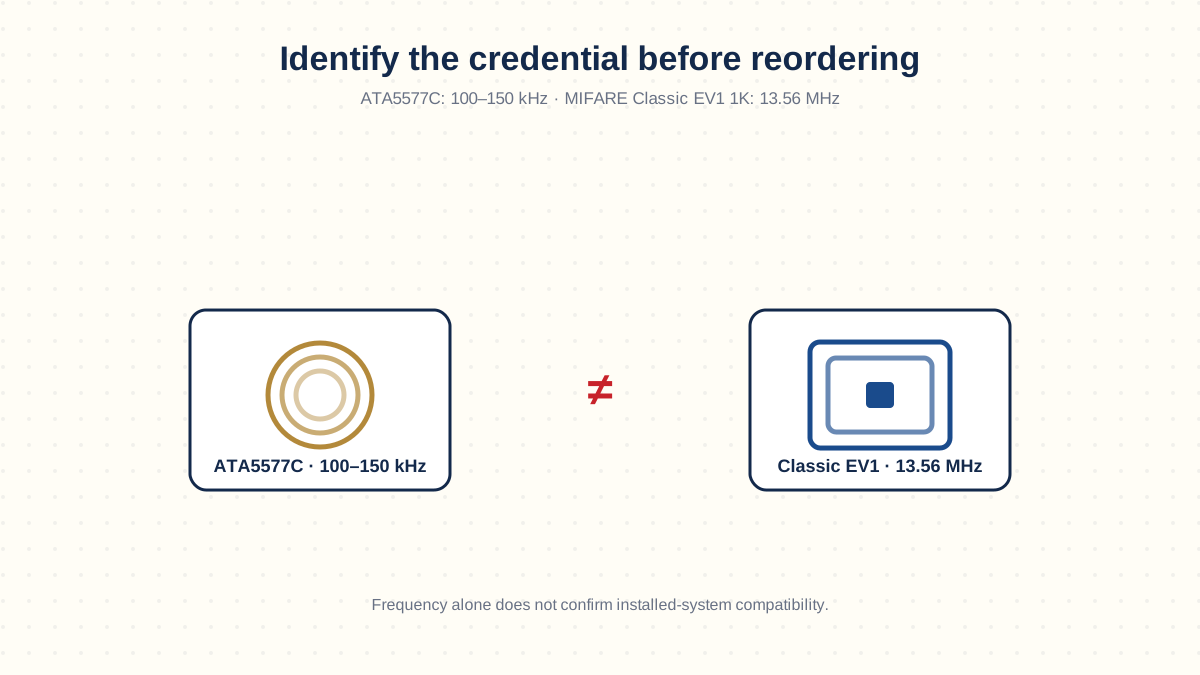
Compare ATA5577C and MIFARE Classic EV1, understand phone NFC limits, and verify the installed lock and encoder specification before ordering hotel key cards.
Start your order
Share your lock and encoder details, quantity per design, artwork and destination. Confirm card options, MOQ, sample costs and delivery in your quote.