
MIFARE Cards Explained: A Practical Guide for Hotels
Understand MIFARE card families, then confirm the exact chip, credential preparation and installed lock configuration before ordering hotel key cards.
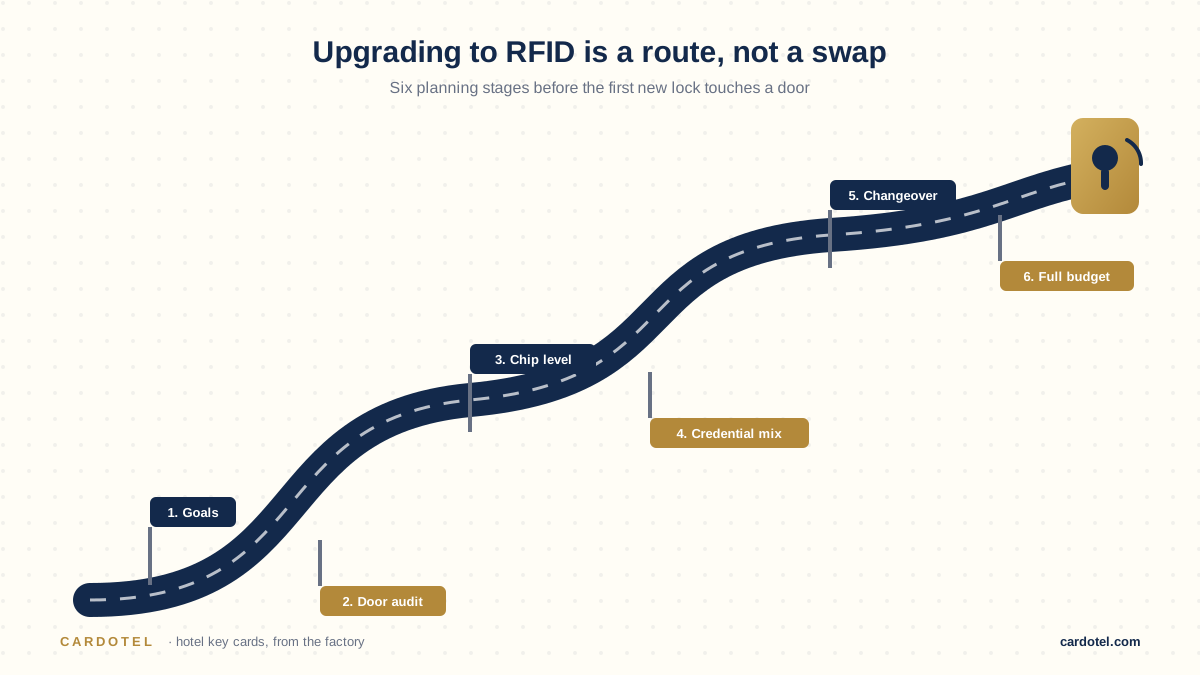
Upgrading hotel locks to RFID is a planning project first and a hardware project second. Write down the problem you are solving, audit each door for retrofit fit, choose between standard and encrypted MIFARE credentials, and budget for cards, encoders, PMS integration and staff training as well as lock bodies. Then decide on a phased or all-at-once changeover, reissue master credentials before the first guest door goes live, and test sample cards in your own locks before approving card stock.
Most renovated mid-scale and upper-scale hotels now read a card at the door rather than a swipe or a metal key, not because of one dramatic security failure but because RFID solves a list of small, recurring problems that add up to real operating costs.
RFID is not maintenance-free: locks still need battery checks and firmware updates, and staff need training on the encoding software, but most properties find that lighter than re-keying and reprinting. Nor is the switch only for new construction; owners replacing worn-out magstripe hardware at end of life often choose RFID because the labour of swapping lock bodies is similar either way. Guests rarely notice the chip. They notice a card that works on the first tap, and a card that fails on the second try reads as a maintenance problem even when it is not your staff's fault.
| Factor | Mechanical key | Magnetic stripe card | RFID card |
|---|---|---|---|
| Lost-credential handling | Replacement key; cylinder work may be needed | Cancellation and reissue workflow | Cancellation and reissue workflow |
| Wear and damage factors | Key and cylinder wear | Stripe contact wear and magnetic exposure | No stripe contact; card or inlay can still be damaged |
| Failure from moisture or humidity | Low risk | Moderate risk (slot exposure) | Low risk (sealed reader) |
| Remote deactivation | Not a feature of the physical key | Depends on installed system | Depends on installed system |
| Extendable to mobile key or wristband | No | Limited | Yes, as a software or credential layer |
| Guest perception | Dated | Neutral | Modern |
An RFID key card carries a small chip and antenna instead of a magnetic stripe. Tapped near a reader, the two exchange a signal that unlocks the door and, on the back end, logs an access event. Hotel cards are almost always passive: no battery, powered by the reader field, which is why a card lasts so long in a guest's pocket. The NFC Forum describes the same 13.56 MHz, short-range, battery-less operation that hotel locks use.
Most hotel RFID cards use a chip from NXP's MIFARE family. The family name alone is not an ordering specification, because each lock generation is configured for a specific variant:
| Variant | Typical memory | Security | Where you will meet it |
|---|---|---|---|
| MIFARE Classic 1K | 1 KB | CRYPTO1; assess legacy security requirements | Existing installations with a confirmed Classic specification |
| MIFARE Ultralight EV1 | 48 or 128 bytes user memory | Limited protection; not an authenticated variant | Systems that specify this exact variant |
| MIFARE Ultralight C (ULC) | 144 bytes user memory | 3DES authentication | Security-updated estates configured for ULC |
| MIFARE Ultralight AES | Depends on the part | AES authentication | Current guest-credential guidance from some lock vendors |
| MIFARE Plus | 2K or 4K in common parts | AES capability; operating security level matters | Provider-planned migration with compatible readers and software |
| MIFARE DESFire | Depends on the generation | Cryptographic and multi-application features vary by generation | Systems configured for the required DESFire applications |
Lock vendors publish their own credential options. dormakaba's key card catalogue lists Ultralight C and Ultralight AES among the credentials for Saflok locks, and Onity's Trillium lock page names MIFARE Classic, Plus, Ultralight and Ultralight C as commonly used options for that reader generation. These are references, not universal brand-to-chip mappings; confirm the installed credential with the authorized provider and validate samples in your own locks. If you do not know which variant your property issues today, follow the chip identification guide before quoting, and see MIFARE cards explained for more on each family.
This is a security-versus-cost decision. Standard credentials are adequate for the large majority of hotels. Encrypted credentials such as Ultralight C, Ultralight AES, Plus or DESFire add a cost premium best justified by luxury positioning, casino operations, an explicit brand security standard, or a vendor security programme you are already inside. Do not default to the highest tier without a reason, or to the cheapest without checking your brand standard. Ask whether the system supports encrypted credentials now or only as a costly future upgrade; the guide to encrypted hotel locking systems weighs that decision in detail.
"Upgrade to RFID" is not a specific goal. Demagnetized-card complaints, a security incident, a brand standard, or a renovation that includes locks each set different vendor priorities, so write the actual problem down before the first sales call. Start from what the property already records: encoding failures, damaged or missing cards, staff time spent on reissue, or a planned lock replacement. A yes to one operational question does not by itself establish the return on the investment.
Some RFID systems retrofit onto existing door prep, reusing the mortise and strike; others need a full hardware swap. Have a vendor walk the property and confirm, door by door, what is retrofit-friendly; this materially changes cost and timeline. Include ADA-compliant rooms from the start and confirm that new hardware meets the same reach-range and operating-force requirements as what it replaces.
Decide whether you are issuing cards only, cards plus wristbands, or building in a mobile-key overlay for later. Then decide on material. Standard PVC is the cost baseline; degradable PVC, wood and paper-based cards take the same RFID inlays, so RFID does not force you to drop a sustainability goal. A material label alone does not establish a lower environmental impact or a disposal route; compare handling and printing behaviour in the key card materials comparison. Material is a guest-facing decision as much as a back-office one.
| Approach | Advantage | Trade-off |
|---|---|---|
| Phased rollout | Lower disruption at any given time; spreads cost over a longer period | Longer total timeline; two systems and two card stocks to manage in parallel |
| All-at-once rollout | Shorter total project; one system to train staff on | Higher short-term disruption; larger upfront cash outlay |
A quote that lists only door hardware is incomplete. Add lines for card stock for initial issue plus a reserve, recurring card reorders as an operating cost, encoding stations and software licences, PMS integration work, staff training time (a real labour cost even when not itemised), and a contingency for doors that prove not to be retrofit-friendly. Ask what a card costs per unit at your reorder volume, not just the headline hardware price. Indicative factory-direct ranges are published in the hotel key card cost guide.
A mobile key is an overlay on an RFID or Bluetooth-capable lock, not a replacement for cards: physical cards remain the fallback, and group or family bookings often prefer a card they can hand off. The article on RFID vs magstripe key cards goes deeper on the first two columns.
| Question | Magnetic stripe | RFID card | Mobile key |
|---|---|---|---|
| Upfront hardware cost | Lowest | Higher than magstripe | RFID or BLE-capable locks plus app licensing |
| Recurring credential failures | Demagnetization near phones and magnets | Physical damage only | Phone battery, app and connectivity |
| Guest fallback | Reissue at desk | Reissue at desk | Physical card still needed |
| Wet or humid environments | Exposed slot wears | Sealed reader | Sealed reader |
| Wristband and amenity extension | Not practical | Same credential in a wristband | Depends on app and lock vendor |
| Best fit | Existing estate with no failure problem and no near-term renovation | Most renovations and end-of-life replacements | Properties already on RFID wanting a check-in bypass for some guests |
Card stock has to match the lock generation, not just the brand. A VingCard property, a Saflok estate that completed its security update and an Onity Trillium property may each issue a different MIFARE variant, and one brand can require a different credential before and after a security programme. Do not assume RFID cards are interchangeable. Record the lock model, encoder, software and current credential, then use the lock compatibility hub to compare the proposed card against the installed system.
Before approving replacement stock, have an authorized operator issue test samples in your own locks and check the required doors and readers, including reissue and expiry. A matching chip family name or a sample photo is not sufficient approval for a supplier change. Finished-card service life depends on construction, handling and reuse rather than chip memory endurance alone, so inspect returned cards and record when and why they fail. Across the hotel key card range, specify chip, material and print finish together so the sample you test is the card you order.
Planning an order? Contact Cardotel with your lock and encoder details, required card or wristband specification, quantity per design and destination. Request a project quote and confirm sample availability, charges, preparation and shipping.

Understand MIFARE card families, then confirm the exact chip, credential preparation and installed lock configuration before ordering hotel key cards.
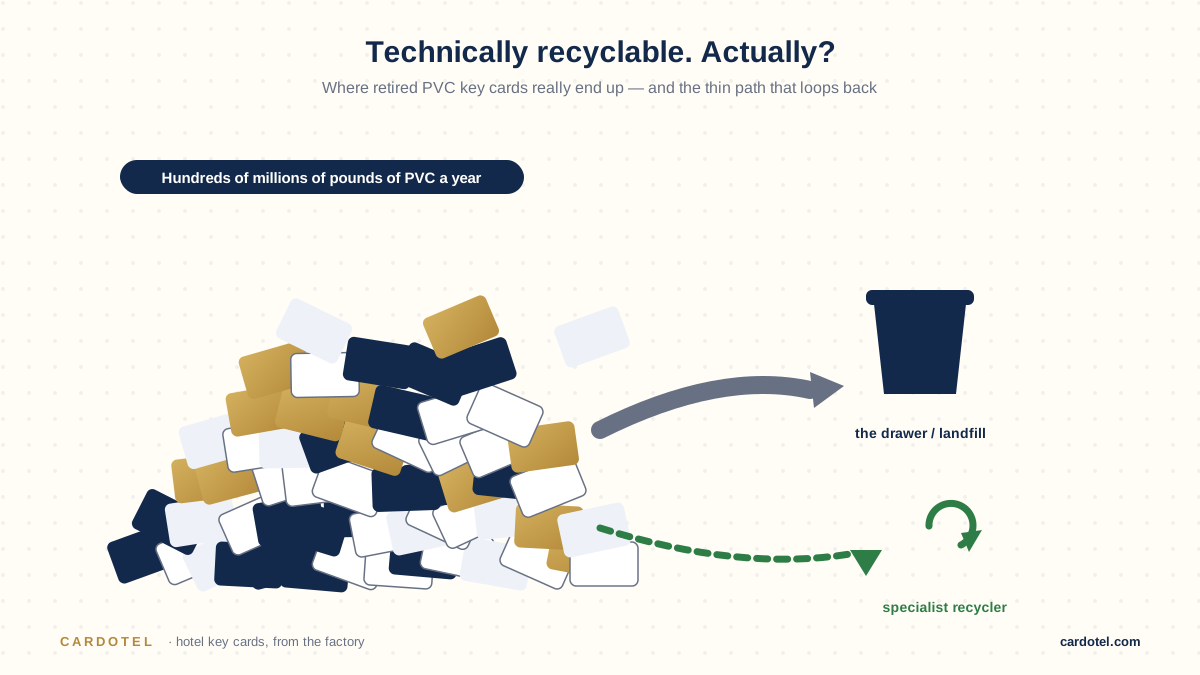
PVC key cards are technically recyclable, but almost none get recycled in practice. Here's which card materials actually can be, and why RFID complicates it.

A practical guide to hotel key cards covering chip types, lock brand compatibility, eco-friendly materials, printing, and costs before you order.
Start your order
Share your lock and encoder details, quantity per design, artwork and destination. Confirm card options, MOQ, sample costs and delivery in your quote.