
Components · Inlay
RFID Inlays & Antenna Materials for Key Cards
The radio inside the card
The RFID inlay combines a chip and antenna with supporting materials. Its design must match the frequency, protocol and lock system.
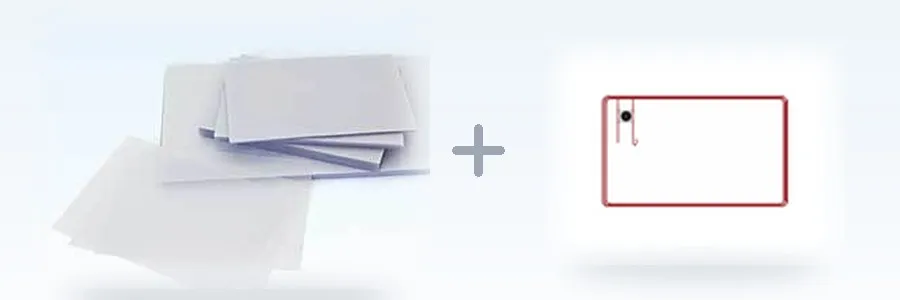
Inlays may use etched aluminum or copper antennas, or wire constructions, with a carrier and bonding layers. Read behavior depends on antenna geometry, chip, surrounding materials and encoder configuration. Bond strength and humidity resistance must be checked on the proposed laminate.
Highlights
Chip and antenna pairing
Frequency alone is insufficient; verify protocol, memory and security configuration.
Mechanical bonding
Assess bending, humidity and lamination effects on the assembled inlay.
System trial
Test finished cards with the actual locks, encoder and software.
Specification checkpoints
- Material option
- Inlay & Antenna
- Illustrative layers
- Core or bonding layer → RFID inlay → Core or bonding layer
- Dimensions
- Confirm film or sheet thickness, width, process tolerances and the dimensions of the finished assembly.
- Material documentation
- Chip identity, antenna design, carrier and bonding specification
- Performance evidence
- Finished-card read tests and mechanical or humidity-test records
How the layers fit together
This diagram explains a possible construction. Layer order, relative thickness and components are illustrative; the supplier specification and approved sample define the ordered build.
Illustrative stack; confirm actual layers and dimensions for the project.
- Core or bonding layer Structural or bonding role depends on the specified laminate.
- RFID inlay Chip and antenna; test the complete assembly with the access system.
- Core or bonding layer Structural or bonding role depends on the specified laminate.
Before approving production
- Record the lock, encoder, software and credential configuration; test the finished sample on the installed system.
- Approve artwork, surface finish, dimensions and the intended handling conditions using a representative sample.
- Confirm minimum quantity, sample and production charges, shipping terms and lead time in the project quotation.
Compare related options
Material questions
What is an etched antenna?
An etched antenna is formed by removing selected metal from foil on a supporting film. Geometry, chip connection and production tolerances influence tuning; etching does not guarantee identical reading distance for every card.
Why does the bonding system matter?
Carrier, core and adhesive must work together during lamination and use. Test peel strength, bending and humidity on the proposed construction; an adhesive datasheet alone does not prove finished-card durability.
Does matching the frequency guarantee lock compatibility?
No. Chip protocol, memory, security configuration, encoding and antenna design also matter. Verify the lock and encoder models and test representative cards with the installed software.
Can the same inlay work in paper, wood and PVC?
Sometimes, but changing surrounding materials, thickness or assembly can change tuning and durability. Validate the finished construction in each material instead of transferring approval from another card body.
Start your order
Planning your next key card order?
Share your lock and encoder details, quantity per design, artwork and destination. Confirm card options, MOQ, sample costs and delivery in your quote.