
Materials · ABS
ABS Key Fobs & Composite Cards
ABS and PVC-ABS blends can be considered for rigid credentials and fobs. Geometry, grade and assembly determine impact and heat performance.
ABS is commonly used for molded housings; blends can also serve card constructions. Compare the finished item for impact, edge wear, chemical exposure and reader fit. No universal operating temperature or impact rating follows from the material name.
Highlights
Rigid formats
Consider molded fobs or card bodies for the required shape and attachment.
Color selection
Pigmented bodies may reduce visible contrast at scratches; verify the sample.
Use-condition testing
Define impact, temperature and cleaning exposure before evaluating the grade.
Specification checkpoints
- Material option
- ABS & Composite
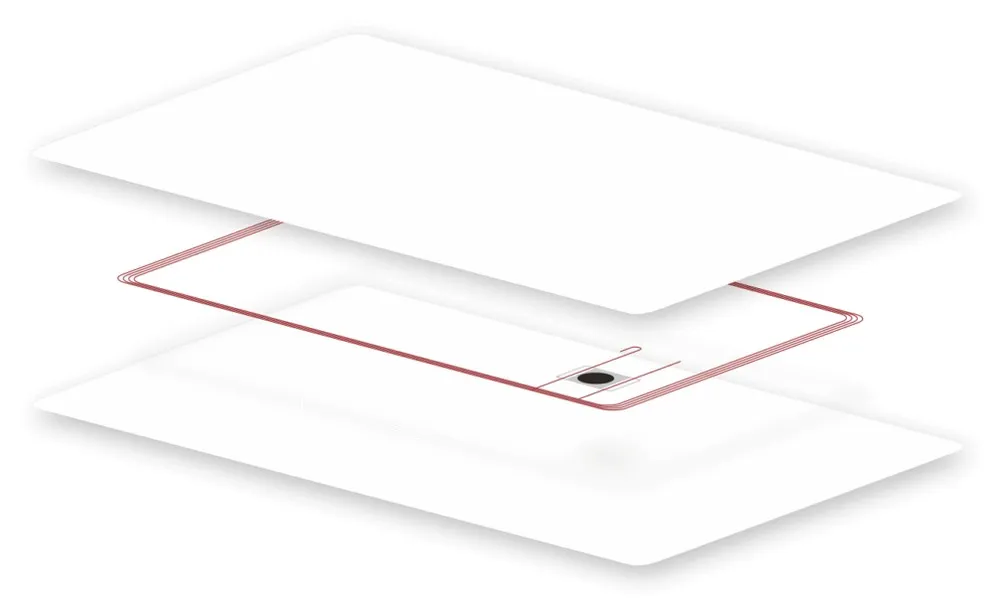
- Illustrative layers
- Core or bonding layer → RFID inlay → Core or bonding layer
- Dimensions
- Confirm footprint, finished thickness, tolerances and encoder clearance on the approved drawing and sample.
- Material documentation
- Resin or blend technical data and finished-item drawing
- Performance evidence
- Impact, temperature and chemical-exposure results for the proposed construction
How the layers fit together
This diagram explains a possible construction. Layer order, relative thickness and components are illustrative; the supplier specification and approved sample define the ordered build.
Illustrative stack; confirm actual layers and dimensions for the project.
- Core or bonding layer Structural or bonding role depends on the specified laminate.
- RFID inlay Chip and antenna; test the complete assembly with the access system.
- Core or bonding layer Structural or bonding role depends on the specified laminate.
Before approving production
- Record the lock, encoder, software and credential configuration; test the finished sample on the installed system.
- Approve artwork, surface finish, dimensions and the intended handling conditions using a representative sample.
- Confirm minimum quantity, sample and production charges, shipping terms and lead time in the project quotation.
Compare related options
Material questions
When should we consider ABS for a credential?
ABS can be useful for rigid molded fobs and housings. Consider the attachment point, dimensions and impact exposure as well as resin choice; a sample should represent the final geometry and assembly.
Is ABS the same as a PVC-ABS blend?
No. A blend has its own composition and processing behavior. Request the exact grade data instead of transferring performance values from pure ABS to a blend or vice versa.
What operating temperature can we specify?
Agree a limit from the selected grade data and finished-item tests. A resin softening temperature is not a guarantee for the chip, adhesive, housing or complete credential over that range.
Do colored bodies hide every scratch?
Pigmentation can reduce contrast between a scratch and the surrounding surface, but scratches and wear remain possible. Compare texture, color and abrasion on samples rather than promising an unmarked surface.
Start your order
Planning your next key card order?
Share your lock and encoder details, quantity per design, artwork and destination. Confirm card options, MOQ, sample costs and delivery in your quote.