
RFID vs Magstripe Key Cards: Which Fits Your Property?
RFID and magstripe key cards differ on cost, lifespan, and maintenance. Compare both technologies to pick the right fit for your hotel's locks and budget.

A hotel key card is the smallest touchpoint a guest has with your property, and one of the easiest to get wrong. Order the wrong chip and it won't talk to your locks. Order the wrong material and it snaps in a coat pocket by day three. Order the wrong finish and your logo looks washed out under lobby lighting.
None of this is complicated once you know what you're actually choosing between. A key card is a small bundle of decisions: the technology inside it, the lock brand it has to be encoded for, the material it's cut from, how it's printed, and the volume you order it in. Each choice has trade-offs, and the right answer depends on your property type, budget, and guest expectations more than on any single "best" option.
This guide walks through those decisions in order, from the chip inside the card to the invoice you'll eventually sign off on, so you can order with confidence instead of guessing.
Strip away the printed plastic and every hotel key card is one of three things: a strip of magnetized material, a chip-and-antenna pair, or, increasingly, both stacked into one card as a hybrid. The strip or chip stores a small amount of data, usually little more than a room number, a validity window, and an access level, that a reader checks against the lock's programming before releasing the latch.
The reader communicates with the stripe or contactless chip and evaluates the credential according to the installed system. Cards commonly carry access identifiers, permissions and validity data, but the exact fields and any additional applications depend on the property’s configuration. Do not assume every hotel encodes the same information.
A magnetic stripe on the back is encoded at check-in for the installed lock system. LoCo (low coercivity) and HiCo (high coercivity) refer to different magnetic encoding requirements. MagTek’s coercivity guidance explains that HiCo is more resistant to external magnetic disturbance; this does not by itself establish longer physical wear life. Confirm the required stripe format and the encoder’s supported coercivity before changing stock.
Magstripe hardware is inexpensive and well understood, which is why it hasn't disappeared. The trade-off is durability and a slightly higher rate of "my key stopped working" complaints compared with contactless formats.
RFID cards carry a chip and antenna instead of a stripe. Tap the card near the reader and the two exchange a signal, no swipe, no slot, nothing to wear out from friction. Most hotel RFID runs on 13.56 MHz high-frequency chips (the MIFARE family is the most common example), which is also the frequency used by contactless payment and transit cards, though hotel-issued cards are provisioned entirely separately from any of that.
RFID avoids the stripe-to-head contact needed for magnetic reading, but finished cards can still suffer physical damage. Lost credentials must be canceled through the installed system’s procedure; the timing at each door depends on connectivity and how updates reach the lock. SALTO’s system overview, for example, describes access updates carried through its virtual network rather than a universal instant change at every offline door.
An encrypted card is still an RFID card, it just adds a layer of cryptographic authentication (commonly AES-based) on top of the basic chip ID, so the card and lock verify each other rather than the lock simply reading a number. That makes cloning or spoofing a card meaningfully harder. Encrypted systems cost more in hardware, software licensing, and per-card price, and they're most common in luxury, casino, and brand-mandated properties rather than limited-service hotels.
Hybrid cards, which combine a magstripe and an RFID chip on one piece of plastic, exist mainly for hotels mid-transition between the two systems, useful for a phased renovation where some doors are upgraded before others, but not worth ordering as a permanent long-term strategy once the full property is on one standard.
Smartphone keys use the same RFID principles, with the credential living in an app instead of a card. They're a genuine convenience for tech-forward guests, but most properties keep physical cards in circulation as a fallback, since not every guest travels with a charged phone and app installed, and physical cards remain the most reliable option for group bookings, families, and older locks that were never wired for Bluetooth.
| Card type | Typical cost | Security | Wear / magnetic exposure | Best fit |
|---|---|---|---|---|
| LoCo magstripe | Lowest | Basic | More susceptible to magnetic disturbance; inspect stripe wear | Budget/economy properties |
| HiCo magstripe | Low | Basic to moderate | More resistant to magnetic disturbance; inspect stripe wear | Midscale hotels replacing an aging system on a budget |
| Standard RFID | Moderate | Good | No stripe-to-head contact; finished card can still be damaged | Most full-service and upper-midscale hotels |
| Encrypted RFID | Highest | Very high | No stripe-to-head contact; finished card can still be damaged | Luxury, casino, brand-mandated programs |
This is where a lot of first-time buyers get tripped up. A key card isn't universally compatible with every lock; the chip technology and encoding format have to match what your lock manufacturer's system expects. Order a generic card that "looks right" and it may simply never be read.
Some of the most common hotel lock brands and what they typically expect:
Before changing suppliers, confirm the installed reader, encoder and software, the exact credential specification, and any required authorized preparation. A current card or part number can help identify what to check, but it does not prove a replacement will work. Agree hotel key card specifications with the supplier and have an authorized operator test the proposed samples on the property’s actual system before approving production.
Material affects three things guests and staff both notice: how the card feels, how long it lasts, and, increasingly, what it says about your property's values.
Compare physical samples of alternative PVC formulations and wood or paper-based cards against a defined PVC construction. Keep appearance and handling decisions separate from disposal claims. The EPA’s recycling guidance explains why local acceptance matters; it is not proof that a particular key card can be recycled.
Most hotel key cards print via offset or digital CMYK, both capable of full-color photography-grade artwork, foil accents, and spot gloss for a logo. Matte finishes resist fingerprints better; gloss finishes photograph better for marketing shots at the front desk.
Standard sizing follows the ID-1 credit-card format (CR80: 3.370 x 2.125 in / 85.60 x 53.98 mm), which is what every standard encoder and most lock readers are built around. A smaller CR50 format exists and shows up occasionally in magstripe systems, and fully custom shapes and sizes are possible for branded add-ons like spa passes or VIP cards, just confirm early that a custom shape still fits your card reader's slot dimensions if you're using a swipe format.
Beyond the logo, properties may print guest instructions, a Wi-Fi network name, facility hours, and front-desk or emergency contact details. Avoid printing a guest’s room number or personal details on the card; a misplaced key should not visibly identify the room it opens.
Four factors move the price more than anything else:
Separate sample preparation, approval, production and transit timing when comparing quotes. The proposed construction and order schedule matter more than a general assumption about which material ships faster.
A key card is only half of the transaction at check-in. The other half is the encoding station at the front desk, the small device that writes a guest's room number, arrival, and departure dates onto a blank card in the few seconds between a guest handing over ID and receiving their key.
Encoders must support the installed credential and issuing software. Where a PMS integration is available and configured, it can carry check-in details into the issuing workflow. Confirm its scope and keep the property’s identity and room-assignment checks; integration does not eliminate operator or configuration errors.
If you're upgrading locks and cards together, ask your vendor early whether encoding hardware and software licenses are included in the quote or billed separately. It's a common gap between what a hotelier expects and what a locking system quote actually covers.
A few habits separate a smooth order from a frustrating one:
Before replacing stock, use the lock and encoder compatibility checks to prepare an on-site sample review. For reorder planning, use the key card cost planner with your own quantity and budget assumptions. These tools do not approve a credential or provide a binding supplier quote.

RFID and magstripe key cards differ on cost, lifespan, and maintenance. Compare both technologies to pick the right fit for your hotel's locks and budget.
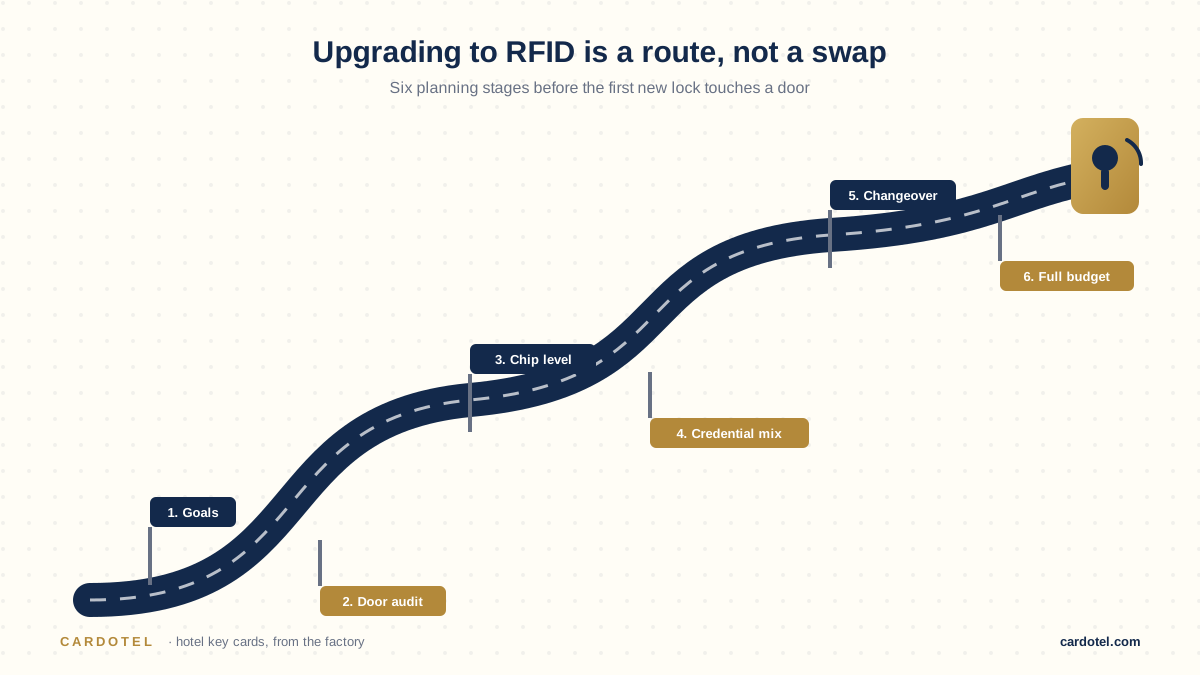
Plan an RFID lock upgrade in 6 steps: why hotels leave magstripe, MIFARE chip families, phased rollout, PMS and encoder checks, and a decision table.
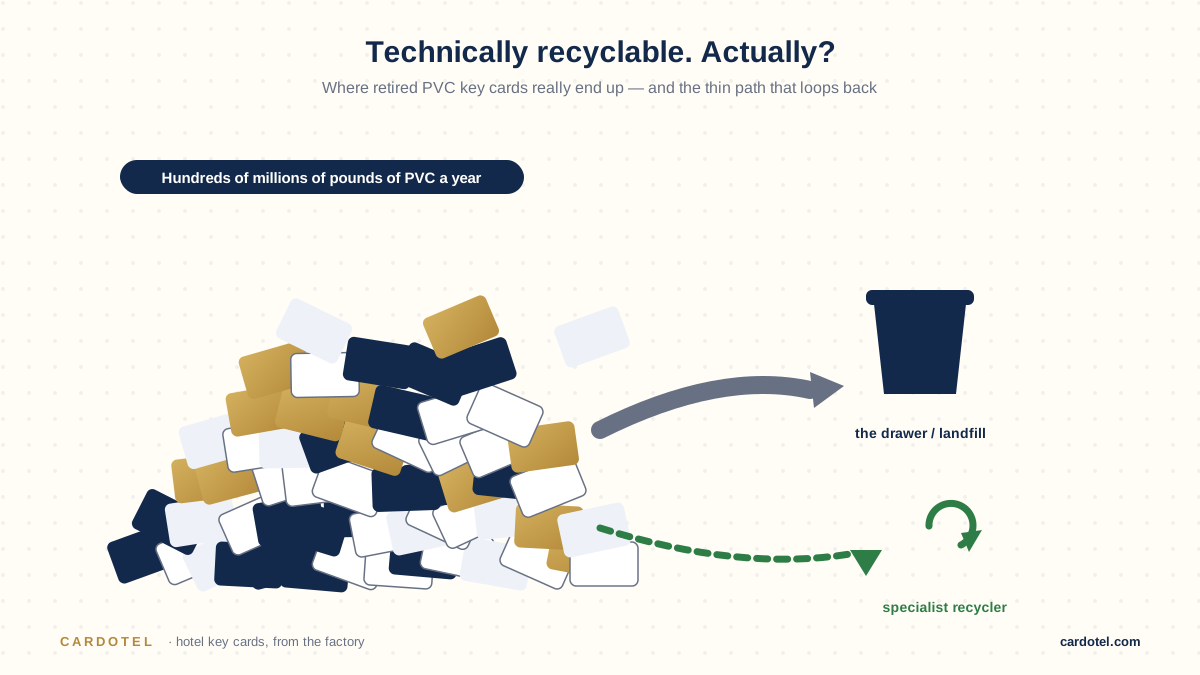
PVC key cards are technically recyclable, but almost none get recycled in practice. Here's which card materials actually can be, and why RFID complicates it.
Start your order
Share your lock and encoder details, quantity per design, artwork and destination. Confirm card options, MOQ, sample costs and delivery in your quote.