
RFID in Hospitality: The Complete Guide Beyond Room Keys
A complete guide to RFID in hospitality beyond room keys, covering access control, resort wristbands, inventory tracking, and staff accountability.

Hotel key card statistics can describe very different things: hotels offering mobile access, digital keys downloaded, or physical cards purchased. This page separates dated figures published by hotel groups from a hypothetical card-volume calculation, so buyers can use the appropriate measure.
Sources checked on September 11, 2026. The published examples below describe 2022 and 2023; they are historical figures, not a 2026 industry adoption estimate.
| Published figure and source | How to interpret it |
|---|---|
| Hilton reported more than 12.3 million Digital Key downloads in 2023. Hilton, January 30, 2024 | Downloads within Hilton’s service, not a count of unique guests or a percentage of all hotel stays. |
| Marriott reported Mobile Key availability at more than 5,500 properties globally. Marriott, July 5, 2022 | Property availability at that date, not the percentage of guests who used a phone to enter their room. |
These measures have different populations and reporting periods. They cannot be combined into a worldwide adoption percentage or used to calculate a hotel’s reduction in physical-card purchases. A survey about guest preferences would be a third measure, separate from either availability or actual usage.
Physical cards can remain useful alongside mobile keys for guests without a compatible phone or app, group travel and operational fallback. Estimate future card demand from the property’s own issue and return records; no Cardotel reorder dataset is available here to quantify a reduction.
Keep cards issued separate from cards purchased: the same reusable card may be issued more than once. Track usable stock, returns, rejected or damaged cards and replacements over a defined period before setting a buying quantity.
Illustrative calculation, not observed Cardotel data or a supplier quote: a 200-room property assuming 5 replacement cards per room per year would budget for 1,000 cards before any separately chosen safety stock. The assumption is for demonstration only; actual use should come from issue, return and rejection records.
A group’s mobile-key rollout does not identify the credential needed by your installed locks. Record the lock and reader models, encoder, software and existing credential specification. Use the key card compatibility finder to organize the information for a sample discussion.
For properties with mixed lock systems, record a separate credential specification for each installation. Consider hybrid chip-plus-magstripe cards only after confirming both issuing and reader requirements; a mixed estate does not itself make one card compatible everywhere.
This page does not establish a fixed reduction in lost cards or unauthorized entry after an RFID upgrade. Assess operational results using a defined incident measure, comparable reporting periods and the actual system configuration. Confirm proposed cards through your property’s authorized sample tests.
Track the number and construction of cards purchased, reused and discarded over a defined period. A material change should be assessed against actual service life, source documentation and the local collection route. See the material comparison for the questions to include in procurement.
Assess the complete card, including the chip, antenna, coatings, laminates and adhesives. Request product-specific composition and test evidence before making an environmental claim. Confirm collection and processing with the local waste operator; a material name does not establish recyclability or compostability. A universal landfill breakdown period or a fixed reuse advantage cannot be inferred without applicable test or lifecycle evidence.
Preparing a purchase? Review the card specification and sample acceptance checklist, then request a project quote using your actual consumption and system requirements. Confirm sample availability and charges, production and shipping in the proposal.

A complete guide to RFID in hospitality beyond room keys, covering access control, resort wristbands, inventory tracking, and staff accountability.

RFID laundry tags let hotels track every towel and sheet from room to laundry facility and back. Here's exactly how the scanning and data loop works.
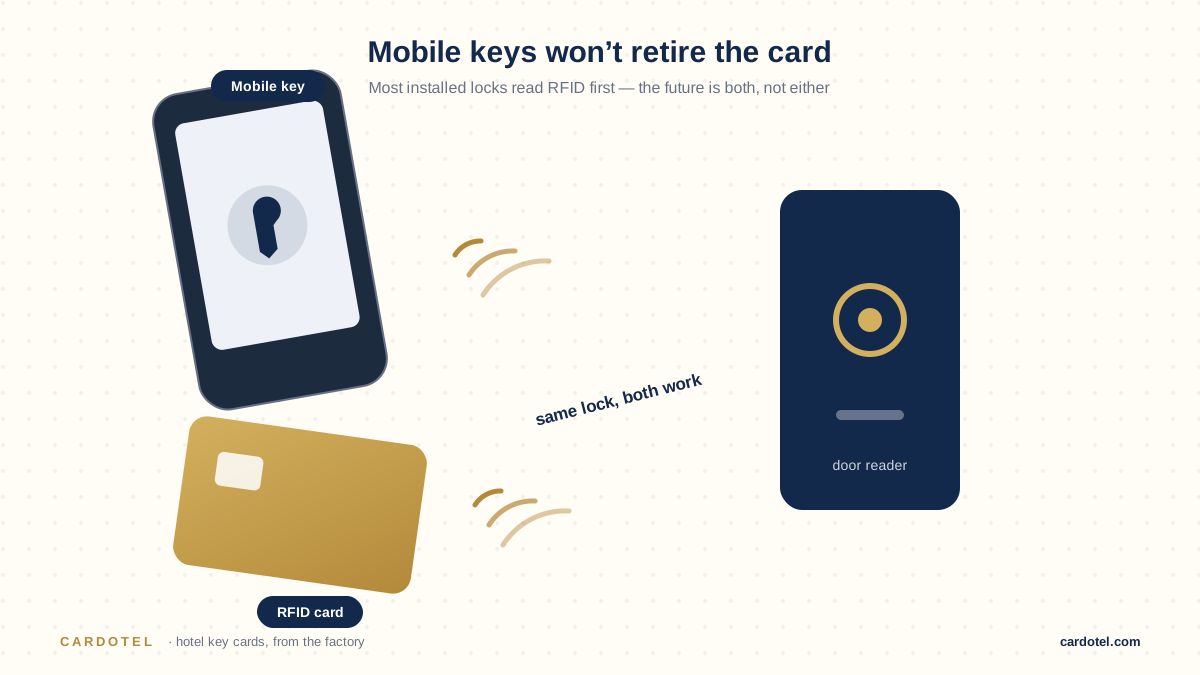
Mobile keys, wearables, and new card materials are reshaping hotel access. Here's a realistic look at what's actually changing and what runs on RFID cards.
Start your order
Share your lock and encoder details, quantity per design, artwork and destination. Confirm card options, MOQ, sample costs and delivery in your quote.