
What Hotels Actually Do With Old Key Cards
Hotels rarely trash key cards after one stay. Here's the real lifecycle of a hotel key card, from check-in encoding to final retirement and disposal.

Ask most travelers what RFID does in a hotel and they'll say "opens the door." That's true, but it's a fraction of what the technology actually does once a property puts it to work. The same chip-and-reader pairing that unlocks a guestroom can track linen through the laundry, log which staff member entered a storage room overnight, and let a guest charge a poolside drink to their wristband without pulling out a wallet.
This guide goes past the door lock to cover where RFID actually earns its keep in day-to-day hotel and resort operations: what it takes to run, where the real payoff shows up, and where the technology still has genuine limits worth knowing before you invest.
None of this requires ripping out what you already have. Most of the applications below layer onto an RFID door lock system a property has already installed, which is exactly why it's worth understanding the fuller picture before assuming your current RFID investment stops at the guestroom door.
Every RFID system has the same three pieces: a tag embedded in a card, wristband, or label; a reader that powers and communicates with the tag; and a backend system that decides what to do with the information. Most hospitality applications use passive tags, which carry no battery and draw their power from the reader's own signal, which is why a key card works indefinitely without ever being "charged."
Active tags carry their own battery and broadcast continuously over a longer range, which makes them useful for tracking higher-value or moving assets, such as a housekeeping cart, a piece of AV equipment, or a staff member in a large property, but they add cost and a battery life to manage. Most hotels use passive tags for guest-facing credentials and reserve active tags for a narrower set of asset- or safety-tracking use cases.
The same credential that opens a guestroom can be scoped to open a pool gate, a gym, a spa corridor, or a back-of-house storage room, each door checking the card against a different access list rather than requiring a separate key for every space. This is also where RFID quietly does loss prevention: if a card is reported lost, deactivating it removes access everywhere at once, not just at the room it was issued for.
Because a reader can identify a guest's credential in a fraction of a second, RFID removes several manual steps from arrival and departure, with no swiping and no re-swiping when a card doesn't read the first time. On resort properties, wristbands extend this further: a guest taps to open their room, taps to enter the pool area, and taps to charge a drink or a spa treatment to their folio, all on one wristband instead of juggling a card, a wallet, and a room key by the pool.
Housekeeping departments lose a surprising amount of money every year to linen that simply walks off property or gets discarded by mistake. RFID tags sewn into linens or attached to reusable equipment let a property scan an entire cart or laundry batch in seconds rather than counting by hand, and flag shrinkage patterns long before they become a real budget problem.
Kitchens use RFID similarly, tagging bulk ingredients or prepared batches so staff can see at a glance how long something has been in storage, rather than relying on handwritten date labels that are easy to skip during a busy shift. This matters for both food safety compliance and reducing waste from ingredients that expire unnoticed.
Employee badges built on the same RFID chip used for guest cards can log entry and exit times for restricted areas, support lone-worker safety programs in properties with large back-of-house footprints, and provide a clear audit trail if an incident needs to be investigated after the fact.
| Use case | Tag type | Primary benefit |
|---|---|---|
| Guestroom and amenity access | Passive (card or wristband) | Convenience, instant deactivation of lost credentials |
| Resort folio charging | Passive (wristband) | Faster transactions, fewer items for guests to carry |
| Linen and equipment tracking | Passive (sewn-in or adhesive tag) | Shrinkage reduction, faster inventory counts |
| High-value asset tracking | Active | Longer read range, real-time location |
| Staff safety and access logs | Passive or active badge | Accountability, audit trail, lone-worker monitoring |
Scaling RFID beyond the guestroom door means treating it as an operations project, not just a hardware purchase. On the hardware side, most properties end up combining a few different reader types:
On the software side, none of this hardware is useful without middleware that translates raw tag reads into information your property management system (PMS) and point-of-sale systems can actually use. This is usually the part hoteliers underestimate: the tags and readers are the easy part to buy, while the integration work to connect them to existing hotel software is where a rollout timeline tends to stretch.
It's also worth asking any prospective vendor how their readers and tags handle frequency and chip-standard compatibility with your existing RFID locks. A system that forces you onto a second, incompatible chip standard for new use cases adds hardware complexity, and a second encoding workflow for staff to learn, that you didn't need before expanding beyond room keys.
Not all RFID operates on the same frequency, and mixing incompatible bands across a property is one of the more common rollout headaches. Guest-facing hotel credentials almost always run on high-frequency (13.56 MHz) chips, the same band used by the MIFARE family, because it offers a good balance of read range, data capacity, and cost for access control and payment use cases.
Low-frequency (125 kHz) tags still show up in some older proximity systems, but they carry less data and are increasingly uncommon in new hospitality installations. Ultra-high-frequency (UHF) tags, which can be read from several meters away, are more relevant to bulk inventory scanning, such as a warehouse-style linen room or a large equipment store, than to anything guest-facing, since that longer range is a liability rather than an asset at a guestroom door.
If you're expanding RFID into a new department, confirm which frequency and chip standard your existing readers use before ordering tags. A mismatched frequency simply won't communicate with your existing hardware, no matter how well-made the tag itself is.
Few properties adopt every use case at once, and trying to is usually a mistake. A more realistic path is picking one operational pain point and proving the value before expanding further:
Starting narrow also gives your team a chance to build internal expertise and work out integration issues on a smaller scale before a full-property rollout multiplies the stakes.
RFID isn't free of downsides, and a fair guide should say so plainly.
Weighed against the labor savings, loss reduction, and guest convenience gains, most mid-size and larger properties find the trade-offs manageable, but they're worth planning for rather than discovering mid-rollout.
Planning an order? Contact Cardotel with your lock and encoder details, required card or wristband specification, quantity per design and destination. Request a project quote and confirm sample availability, charges, preparation and shipping.
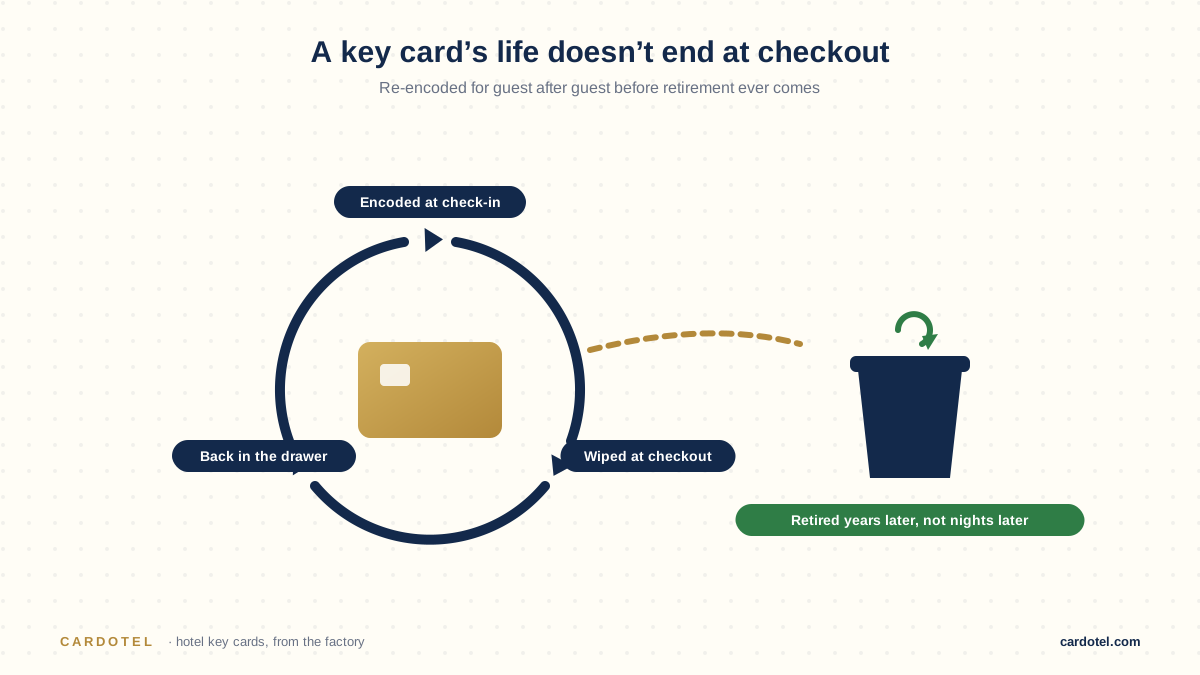
Hotels rarely trash key cards after one stay. Here's the real lifecycle of a hotel key card, from check-in encoding to final retirement and disposal.
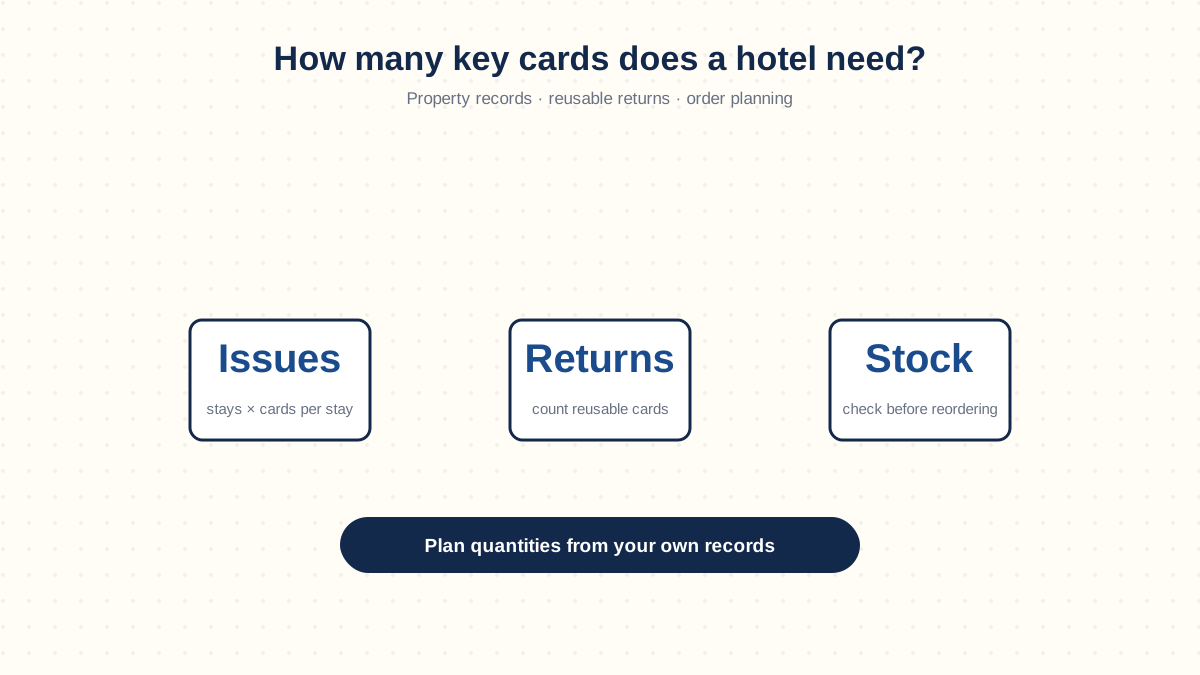
Estimate hotel key card replacements from stays and reusable returns, then plan order quantities, stock reserves and reorder timing with worked examples.

RFID laundry tags let hotels track every towel and sheet from room to laundry facility and back. Here's exactly how the scanning and data loop works.
Start your order
Share your lock and encoder details, quantity per design, artwork and destination. Confirm card options, MOQ, sample costs and delivery in your quote.